
Sockrade saffranssnurror
A pinch-me moment, wrapped in saffron and sugar

[Sugar-coated saffron swirls]
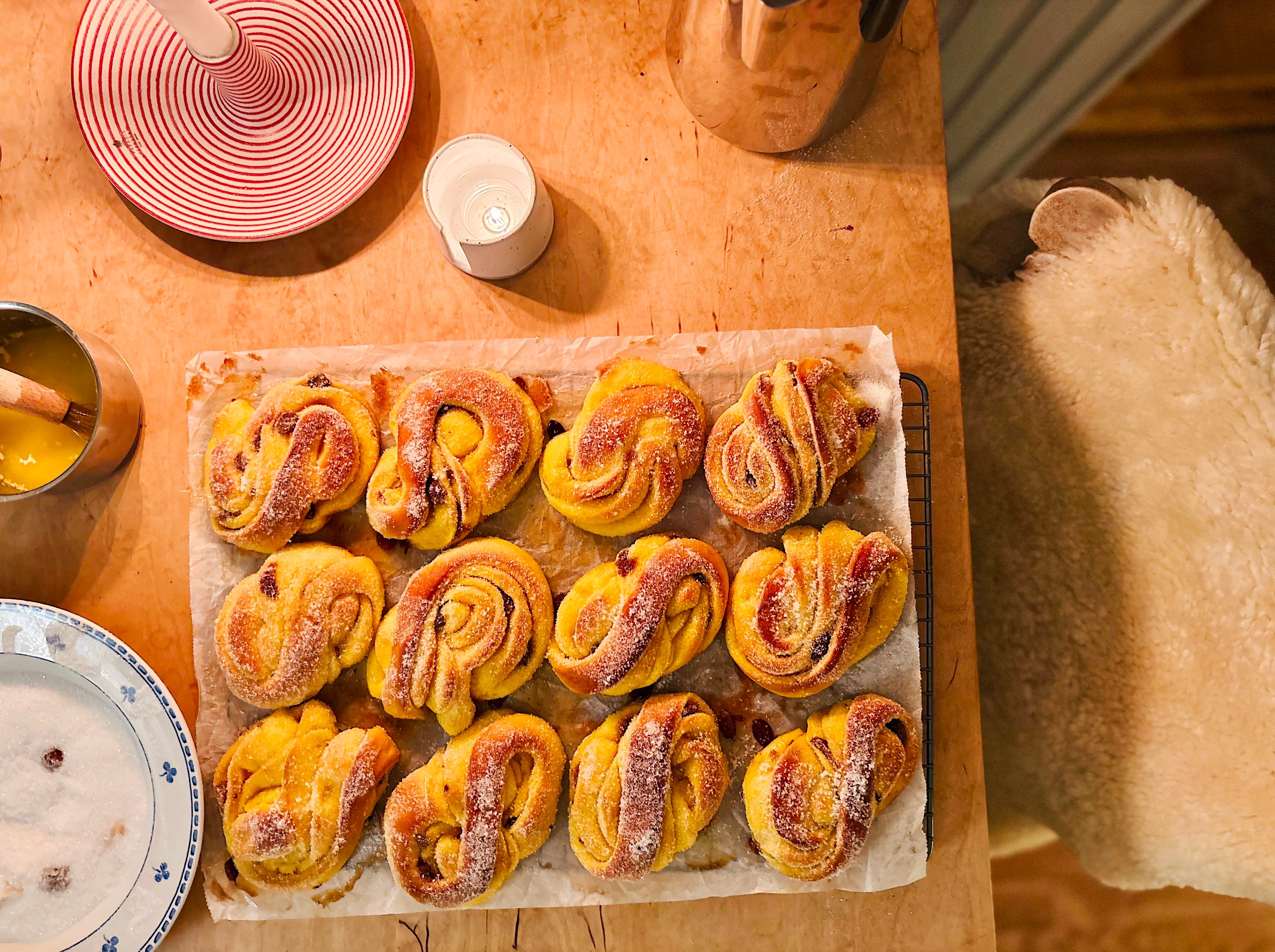
Even when there is, really, no rush at all, December has a way of moving too quickly. Days that blur into each other, lists that grow longer… The numbered candle we light each day shortens almost faster than expected.
Yet every so often, everything pauses. A small, ordinary moment opens up and asks to be remembered.
One happened at our kitchen table, lit by the paper-star at the window and the extraordinary three-armed candle I bought at the Christmas market last year. It was last Monday.
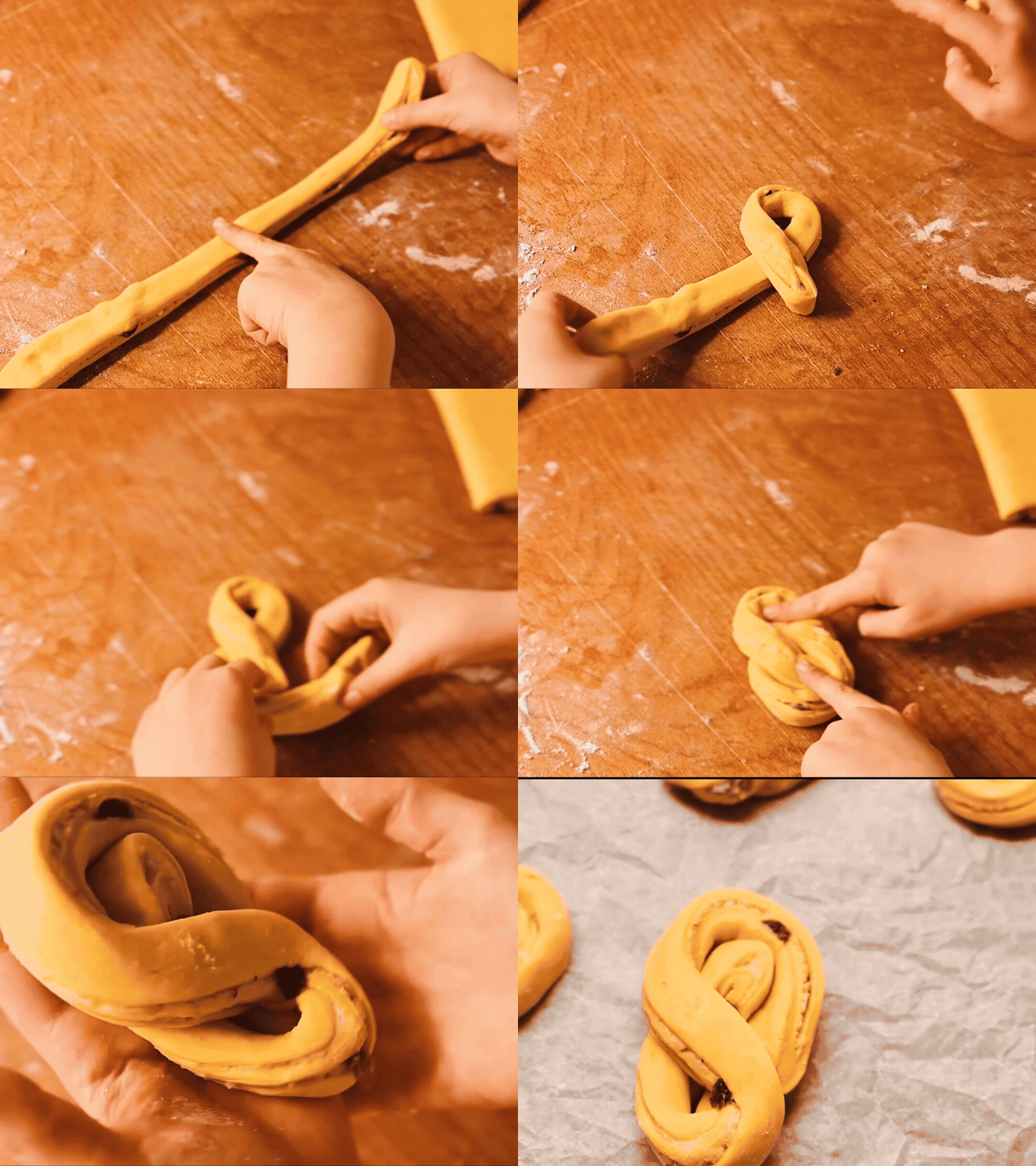
Butter softening on the counter. Raisins plumping in a pan of boiling water. Sienna rolling the dough onto our wooden bakbord, folding it into thirds. I cut it into strips and showed her how to shape them into my absolute favourite, reminiscent of traditional lussekatter.
I shaped one. She shaped the other twenty-three.
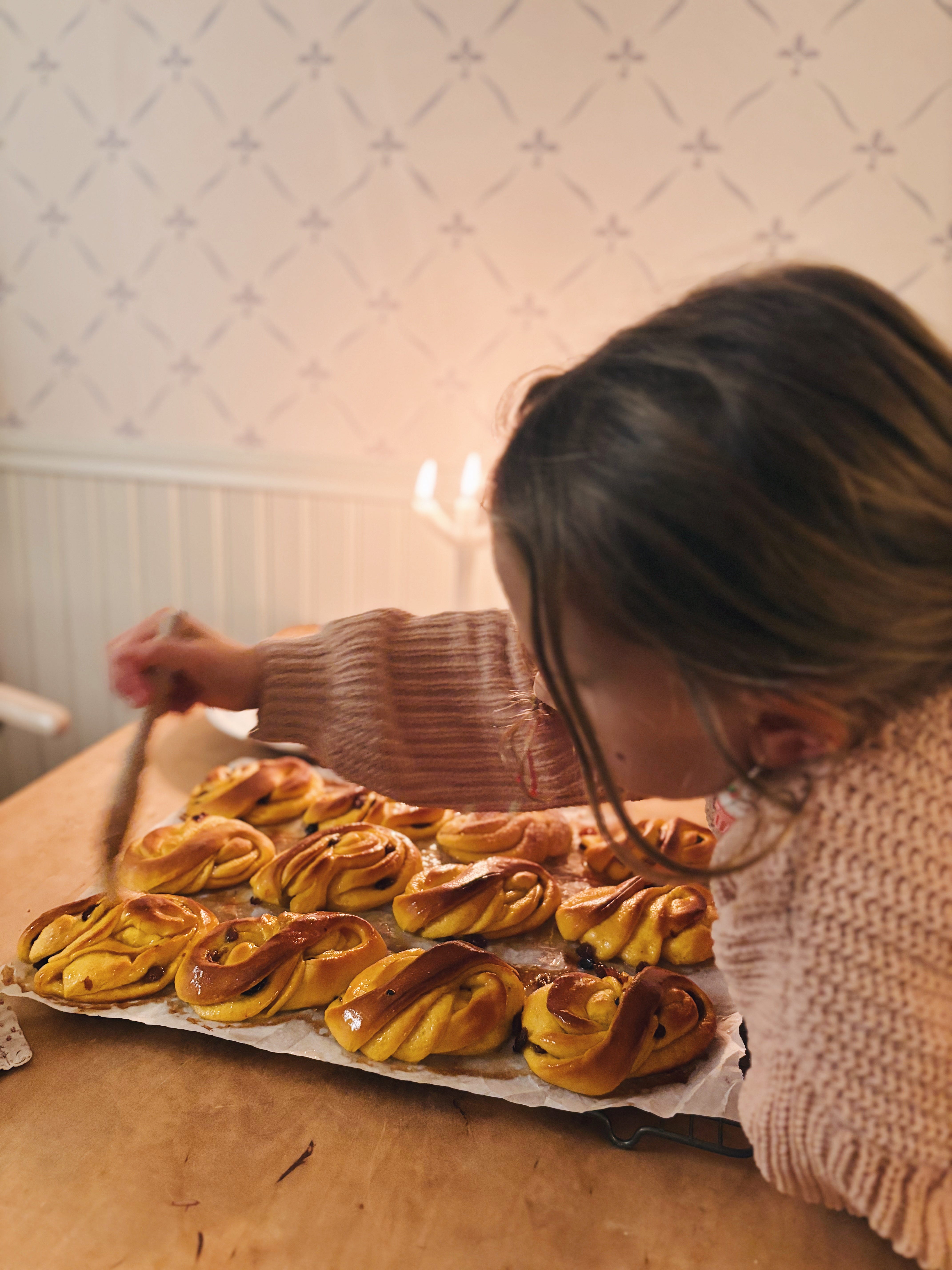
When the buns came out of the oven, still slightly warm, we brushed them in melted butter and rolled them in sugar. She took one bite, looked at me and whispered, “Maman… de är de godaste bullar någonsin.”
Right then, it felt as though I was exactly where I needed to be. Sienna’s maman. With Advent underway. And saffron buns in the oven. K, always.
Sockrade saffranssnurror
Traditional lussekatter are coils of a simple saffron dough, finished with two raisins pressed into place. I am fond of them, very much so. But here, the filling melts into the crumb, giving the softest of buns, with raisins threaded all the way through – a plus, if, like me, you belong to the small but devoted club that adores them.
Yes, these are, for me, everything I love about lussekatter, and more besides. The brioche-like saffron dough is rolled and layered with a filling of butter and sugar, generously studded with plump raisins. If you feel like it, a small splash of cognac or rum does wonders here.
Brushed with melted butter and coated in sugar, these buns are indeed, as Sienna said, the best in the world.
Notes
On fresh yeast
I work exclusively with fresh yeast, a staple in every supermarket in Sweden.
If using instant yeast instead, use about one-third the amount:
25 g fresh yeast = 8 g instant yeast (about 2½ tsp).
On salted butter
If you’d asked me years ago about my thoughts on salted butter, I might have given a plain: Non!
But after living in Sweden for the past ten years, I now bake exclusively with salted butter – and honestly, I’m never going back. That said, I have to admit it makes writing recipes a bit trickier, as the salt content in butter varies widely across the globe. Here in Sweden, it’s typically 1.2%.
Tip: If using unsalted butter, just add a little extra salt and adjust to taste.
On incorporating the butter
I used to always develop the dough fully before working in the butter – and I still do when I’m making very rich, high-fat doughs. But these days I often add the butter right at the beginning. It’s a little easier, and for this dough it works just as well.
On freezing the unbaked buns
This recipe makes 24 saffranssnurror, but most often I bake only 12 at a time. I make the full batch, bake half, and freeze the remaining buns unbaked, placed directly onto a parchment-lined tray.
The evening before I want to bake them, I take the tray out of the freezer. If I want the buns for breakfast, I cover them loosely with clingfilm and leave them to prove overnight in a cool spot in my kitchen (for reference, it’s usually around 21-22°C in our house). In the morning, I bake them as soon as the oven is hot.
If I want them for later in the day, I place the tray of frozen buns, covered, in the fridge overnight. In the morning, I take them out and let them prove in the oven with just the light on (no heat) for about 1 hour, until puffy and soft to the touch. Bake as usual.
